
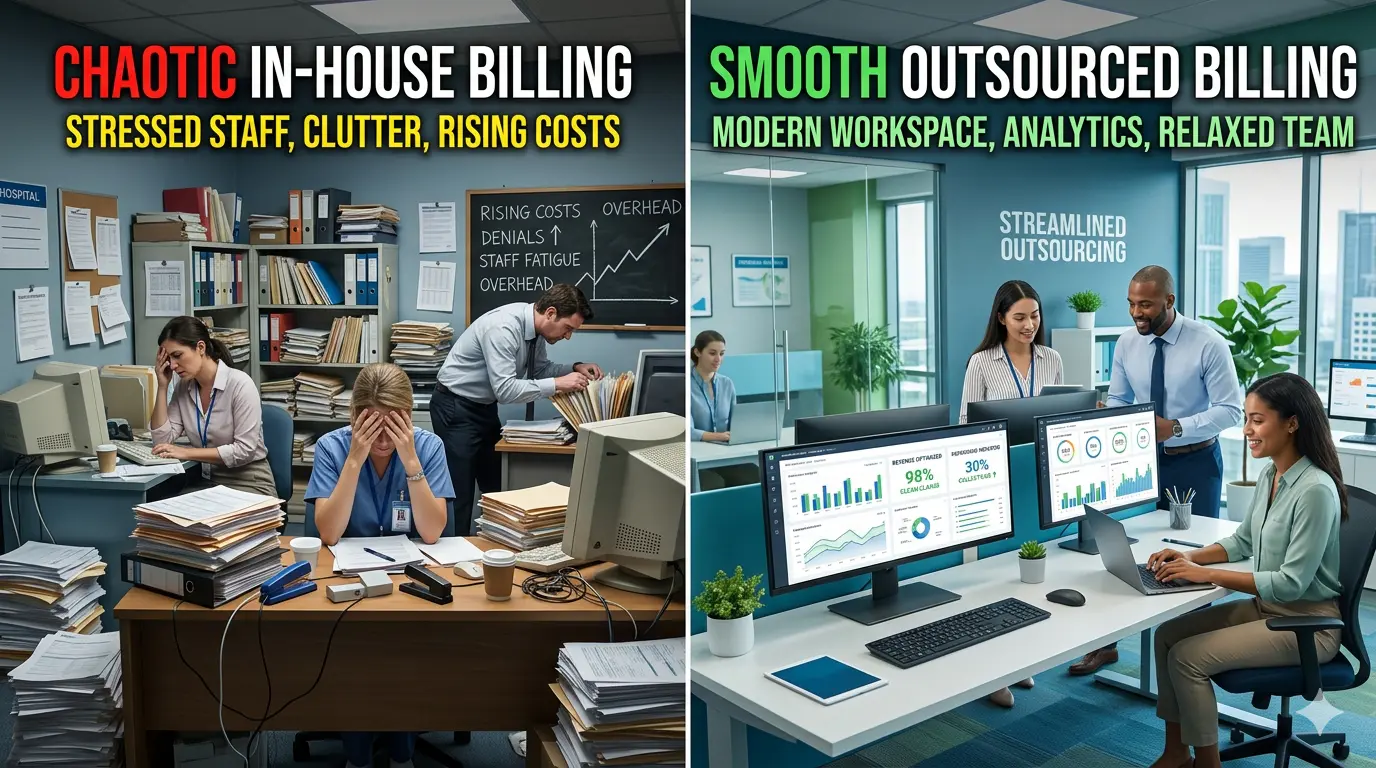
Running a medical practice requires your full energy and attention. You want to focus on caring for your patients and offering them the best possible treatment. At the end of the day, however, you are also running a business. If cash flow stops, the entire clinic suffers.
One of the biggest dilemmas you face as a healthcare provider is how to handle your billing. For years, the default option was to hire an in-house team. It seemed logical to have someone in the next office processing claims. But the rules of the game have changed drastically over the last few years.
Medical coding becomes more complex every single year. Insurance companies constantly find new ways to delay payments or deny claims altogether. Furthermore, the operational costs of maintaining a clinic continue to rise. Faced with this reality, many doctors wonder if keeping billing in the office is still profitable.
Understanding exactly where your money goes will help you make an informed decision. In this guide, we will deeply analyze the true costs of in-house medical billing versus outsourcing. We will explore which model better protects your revenue and sets you up for financial success in 2026.
The True Cost of In-House Medical Billing
At first glance, having your own medical biller seems like the safest option. You feel like you have total control over the process. You can walk right up to their desk and ask a question at any given moment. However, that control comes with a very high price tag that often goes unnoticed.
When you calculate the cost of an internal billing department, you cannot look at the base salary alone. There are a series of fixed and variable expenses that silently drain your monthly budget. Let us break down what you are actually paying for.
Staff Salaries and Employee Benefits
The biggest expense of internal billing is human capital. An experienced medical biller demands a highly competitive salary in today’s market. But the paycheck is only the beginning of your financial commitment.
As an employer, you must also cover payroll taxes, health insurance, paid vacation days, and retirement contributions. These additional benefits usually add another twenty to thirty percent on top of the base salary.
What happens when your biller gets sick or takes a two-week vacation? The invoices stop going out. Claims start piling up on a desk. Your cash flow freezes temporarily, but your operational expenses keep running. Hiring backup staff to cover these gaps only multiplies your payroll costs.
Software, Technology, and Compliance Maintenance
Modern medical billing requires advanced technology. If you manage this process internally, you are solely responsible for buying and maintaining these expensive tools.
You need practice management (PM) software licenses and electronic health record (EHR) systems. These platforms charge hefty monthly or annual subscription fees. Additionally, you must consider the cost of IT support, system updates, and robust data security.
Protecting patient information under privacy rules requires secure servers and constant encryption. To understand the strict requirements of health data security, you can review the official privacy guidelines from the U.S. Department of Health and Human Services at https://www.hhs.gov/hipaa/index.html. Meeting these strict standards on your own is costly and takes up a massive amount of your time.
Continuous Training and High Turnover Rates
The medical industry never stands still. Diagnostic codes are updated annually, adding layers of complexity to an already difficult job. Insurance companies frequently change their claim submission rules without any prior notice.
Your staff needs constant training to keep up with these sudden changes. You have to pay for those courses, seminars, and certification renewals. If you skip this step, your staff will make coding errors that result in instant claim denials.
Worse still, the healthcare sector faces incredibly high employee turnover rates. If your lead biller quits, you are left with a massive gap in your operations. You will have to spend time and money posting job ads, interviewing candidates, and training a new employee from scratch. During that transition period, your revenue will inevitably take a hit.
Hidden Overhead Expenses
Every internal employee occupies physical space in your clinic. That space requires a desk, an ergonomic chair, a fast computer, multiple monitors, office supplies, and high-speed internet.
A larger team also means higher electricity and utility bills. If you add up all these small expenses over the course of a year, the final number will shock you. That is money you could easily invest in new medical equipment or improving the overall patient experience.
The Financial Benefits of Outsourced Medical Billing
Outsourced medical billing means partnering with a specialized company that handles your clinic’s entire revenue cycle. Instead of paying fixed employee salaries, you typically pay a small percentage of the revenue they successfully collect for you.
This model aligns the interests of both parties perfectly. The billing company only makes money if you make money. Let us look at why this option is emerging as the most profitable strategy for medical practices in 2026.
Drastic Reduction in Denied Claims
The biggest revenue killer in any medical practice is a denied claim. Every time an insurance company rejects an invoice for a typo or an incorrect code, you lose money. Tracking down that claim, fixing the error, and resubmitting it costs your practice valuable time and resources.
Outsourced billing companies employ teams of expert auditors. They use advanced software to scrub and review every single claim before sending it to the insurance provider. This initial “cleaning” process catches human errors instantly.
By sending clean claims on the very first try, your denial rate drops significantly. You receive your payments much faster, which stabilizes your monthly cash flow. According to revenue cycle reports from the Centers for Medicare & Medicaid Services read more about billing policies, accuracy on the first submission is vital for long-term profitability.
Immediate Access to a Team of Experts
When you outsource, you are not just hiring one person. You are hiring an entire team of certified billing specialists.
These professionals dedicate their entire workday to understanding the nuances of medical coding. They know exactly how to deal with the most difficult insurance companies. They understand appeal deadlines, specific code modifiers, and aggressive negotiation tactics.
You get the benefit of all this accumulated knowledge without having to pay corporate salaries. If one specialist gets sick, another team member seamlessly takes their place without interrupting your collections. You never have to worry about staff vacations or unexpected absences again.
Savings on Infrastructure and Office Space
By moving the billing workload out of your office, you free up highly valuable real estate. You can convert that old billing office into a brand new exam room to see more patients.
You will no longer have to pay for expensive billing software licenses or deal with frustrating IT updates. The external company absorbs all operational, technological, and data security costs. These expenses shift from being your fixed costs to being theirs.
High Scalability and Flexibility
Medical practices experience natural ebbs and flows in patient volume. During a busy flu season, you might see twice as many patients as you do during the summer months.
If you have an in-house biller, you pay them the same fixed salary regardless of how many claims they process. If they get overwhelmed during a busy month, claims get delayed.
Outsourcing offers total flexibility. Because you pay a percentage of collections, your billing costs scale perfectly with your revenue. If you have a slow month, your billing expenses naturally drop. If your practice grows rapidly, the outsourced team easily absorbs the extra volume without you needing to hire and train new staff.
Direct Comparison: Which Model Wins in 2026?
To make the final decision, let us put both models head-to-head.
- Upfront Costs: The in-house model requires a high initial investment in recruitment, hardware, and software licenses. The outsourced model has practically zero startup costs.
- Ongoing Expenses: The in-house model demands fixed salaries, benefits, and taxes, regardless of how much revenue the clinic generates. The outsourced model charges a success-based percentage, keeping your overhead incredibly low.
- Staff Management: The in-house model forces you to act as an HR manager, dealing with conflicts, schedules, and turnover. The outsourced model completely eliminates this administrative headache.
- Speed of Payment: Internal teams easily get overwhelmed, which delays claim submissions. External companies process claims daily with high efficiency, vastly accelerating your reimbursements.
- Regulatory Updates: In the internal model, you must pay for your team’s continuing education. An external company stays updated on their own dime and applies new coding rules immediately.
The numbers speak for themselves. For the vast majority of independent and mid-sized medical practices, outsourcing offers a far superior return on investment.
Why Your Practice Deserves Financial Peace of Mind
Professional burnout among physicians is a very real and growing problem. A large portion of that stress does not come from patient care, but rather from the heavy administrative burden of running a business.
Spending your nights or weekends reviewing revenue spreadsheets and arguing with insurance representatives is simply not sustainable. It steals the valuable time you should spend resting or enjoying life with your family.
Outsourcing your medical billing gives you that time back. It allows you to regain total focus on practicing medicine. You will have peace of mind knowing there is a team of experts working diligently behind the scenes, ensuring every cent you earned reaches your bank account.
As we move through 2026, healthcare technology and billing regulations will continue to shift. Staying afloat requires agility and deep expertise. Entrusting this critical task to dedicated specialists is the smartest way to protect your practice against inflation and declining reimbursement rates.
Conclusion
The decision between keeping medical billing in-house or outsourcing it comes down to a matter of efficiency and peace of mind. While the direct control of an internal employee seems tempting, the hidden costs of salaries, software, human errors, and staff turnover will quietly devour your profits.
The outsourcing model eliminates high fixed expenses, drastically reduces claim denials, and greatly accelerates cash flow. By trusting this laborious task to experts, you secure a healthy bottom line and free your local team to provide a better patient experience in the clinic.
Stop losing money to simple coding errors and delayed claims. If you want to optimize your revenue and reduce administrative stress, trust the real experts. At ApexMedex, we specialize in transforming your revenue cycle and maximizing your collections with total transparency. Visit ApexMedEx and discover how we can help your medical practice grow without limits in 2026.
Frequently Asked Questions (FAQs)
Do I lose control of my financial data if I outsource my billing?
No, a reputable billing service provides detailed reports and highly transparent access to your financial data 24 hours a day.
Is outsourced billing a good fit for small or solo medical practices?
Yes, small clinics actually see the greatest savings because they completely eliminate the massive cost of keeping a full-time employee on payroll.
How long does it take to transition from in-house to outsourced billing?
The onboarding process is fast and guided by experts; most clinics complete a seamless transition without interrupting cash flow within a few weeks.
Recent Comments