
You visit the doctor, get your checkup, and head home. For you, the appointment is over. But behind the scenes, a completely different process is just beginning. Have you ever wondered how your doctor actually gets paid for the services they provide?
Healthcare providers do not simply hand a price tag to the insurance company. Instead, they rely on a highly detailed, systematic process to translate medical procedures into billable revenue. This system is the backbone of the healthcare industry, ensuring that doctors can keep their doors open and patients receive the care they need without administrative chaos.
Let’s break down exactly what medical billing and coding involves, how the two functions differ, and why getting them right is so important for modern healthcare facilities.
The Foundation of Healthcare Administration
When we think about healthcare, we usually picture doctors, nurses, and medical equipment. We rarely think about the massive amount of paperwork and data processing that happens in the background. Yet, without proper administration, clinics and hospitals simply cannot function.
Every time a patient receives care, someone has to document what happened, why it happened, and what supplies were used. This information must then travel from the healthcare provider to the insurance company, and eventually to the patient’s mailbox in the form of a final bill. Medical billers and coders are the professionals who manage this complex flow of information. They act as translators and negotiators between healthcare providers, patients, and insurance companies.
What is Medical Coding?
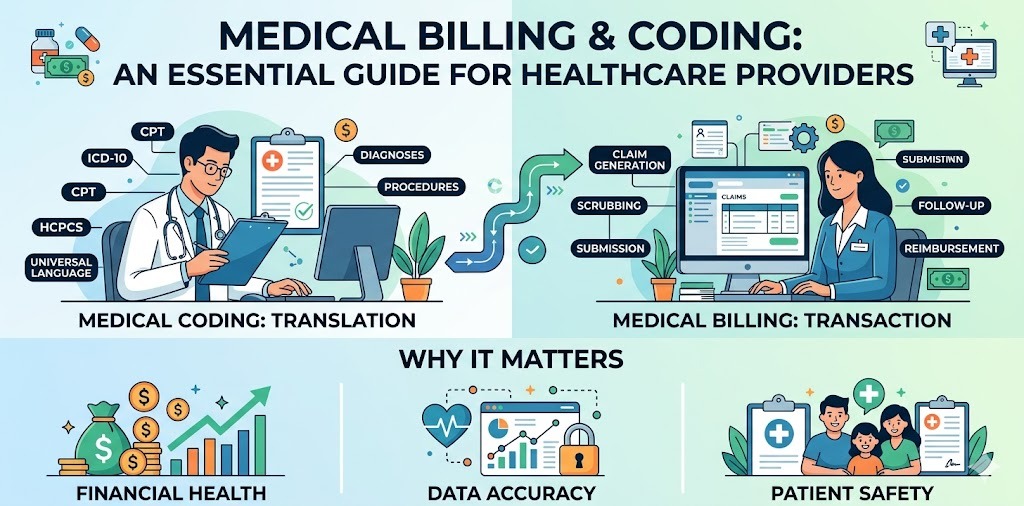
Medical coding is the first step in the reimbursement process. It is the act of taking a doctor’s medical notes and translating them into a universal alphanumeric code.
Think of it as a specialized language. A doctor might write a detailed paragraph about a patient coming in with a severe sore throat, receiving a rapid strep test, and being prescribed antibiotics. A medical coder reads that specific chart and converts the diagnosis and the treatment into standardized codes.
The Universal Language of Medicine
Why do we need this translation? Insurance companies process millions of claims every single day. If they had to read every doctor’s handwritten or typed notes, the system would instantly bottleneck. Codes provide a standardized, highly efficient way to communicate exactly what happened during a patient encounter.
Coders review clinical statements and assign standard codes using specific classification systems. These professionals must have a deep understanding of anatomy, physiology, and medical terminology to ensure they select the absolute correct code for the service provided.
Key Code Sets You Should Know
Coders rely on three main sets of codes to do their jobs effectively:
- ICD-10 Codes: The International Classification of Diseases is used to describe the patient’s diagnosis. It answers the question, “What is wrong with the patient?” For example, there is a specific ICD-10 code for a sprained right ankle, and a completely different code for a sprained left ankle.
- CPT Codes: Current Procedural Terminology codes describe the specific treatments and services the healthcare provider performed. This answers the question, “What did the doctor do?” This covers everything from a routine checkup to a complex surgical procedure.
- HCPCS Codes: Healthcare Common Procedure Coding System codes are typically used for Medicare and Medicaid patients. They cover products, supplies, and services not included in the CPT codes, such as ambulance rides, wheelchairs, and specific medications. You can learn more about these national standards directly through the Centers for Medicare & Medicaid Services (CMS.gov).
What is Medical Billing?
If medical coding is the translation, medical billing is the financial transaction. Once the medical coder has assigned the appropriate codes to a patient’s visit, the medical biller takes those codes and creates a claim to send to the insurance company.
The biller’s primary goal is to ensure the healthcare provider is properly reimbursed for their work. They take the clinical data and turn it into financial data.
Turning Codes into Revenue
The billing process starts long before the patient even sees the doctor. It begins at the front desk when the patient’s insurance information is collected and verified. The medical biller uses this information to understand the patient’s coverage, including their copayments, deductibles, and co-insurance.
After the visit and the coding process, the biller compiles all the information into a “superbill.” This document includes the provider’s information, the patient’s demographic information, and the medical codes.
The Claim Submission Process
Submitting the claim is just the beginning of the biller’s job. The typical process looks like this:
- Claim Generation: The biller creates the claim using the codes provided by the medical coder.
- Claim Scrubbing: Before sending the claim, the biller checks it for errors. This is crucial because even a tiny mistake, like a misspelled name or an incorrect birth date, can cause an insurance company to reject the claim.
- Submission: The claim is sent to the insurance company, usually electronically.
- Following Up: The biller monitors the claim’s status. If the insurance company denies or rejects the claim, the biller must investigate the reason, correct any errors, and appeal the decision.
- Patient Billing: Once the insurance company pays its portion, the biller calculates what the patient still owes and sends them a statement.
Medical Billing vs. Medical Coding: What’s the Difference?
Because these two terms are often grouped together, it is easy to assume they are the same job. While they are closely related and work together as part of the revenue cycle, they are distinct processes. In smaller clinics, one person might handle both tasks. In larger hospitals, they are usually separate departments.
Here is a quick breakdown of how they differ:
- Focus: Coders focus on clinical data and medical terminology. Billers focus on financial data and insurance policies.
- Primary Task: Coders translate medical records into codes. Billers translate codes into financial claims.
- Interaction: Coders rarely interact with patients or insurance companies directly; they work primarily with medical records and doctors. Billers frequently communicate with insurance representatives and patients to resolve payment issues.
- End Goal: The coder’s goal is accurate documentation of the patient encounter. The biller’s goal is securing accurate payment for the practice.
Why Are Medical Billing and Coding Important?
You might think that administrative tasks are secondary to patient care. In reality, excellent healthcare administration is what makes excellent patient care possible. Without accurate billing and coding, the entire healthcare system would grind to a halt.
Keeping Practices Financially Healthy
Healthcare facilities are businesses. They have rent to pay, staff to compensate, and expensive equipment to maintain. If a practice cannot collect revenue efficiently, it cannot survive.
Accurate medical billing and coding ensure that doctors are paid fairly and promptly for the services they provide. When codes are missed or claims are delayed, cash flow suffers. By maintaining a clean, efficient revenue cycle, practices can reinvest their resources into better patient care, rather technology, and more comfortable facilities.
Ensuring Patient Safety and Data Accuracy
Coding is not just about money. It is also about keeping accurate health records. The codes assigned to a patient’s visit become a permanent part of their medical history.
If a coder makes a mistake, it could have serious consequences down the line. A wrong diagnosis code could impact a patient’s ability to get life insurance or cause confusion for future healthcare providers. Accurate coding ensures a clear, correct medical history, which is vital for long-term patient safety. Furthermore, public health officials use this aggregated coding data to track diseases, monitor health trends, and allocate medical resources across the country.
Common Challenges in the Billing Cycle
The revenue cycle is incredibly complex, and there are many places where things can go wrong. Healthcare regulations and insurance policies change constantly, making it difficult for administrative teams to keep up.
Some of the most common challenges include:
- Claim Denials: Insurance companies have strict rules. If a claim does not meet their exact requirements, they will deny it. Handling denials takes time and money away from the practice.
- Coding Errors: Using an outdated code, under-coding (leaving out a service that was performed), or over-coding (billing for a more complex service than was provided) can lead to audits, fines, and lost revenue.
- Changing Regulations: The healthcare industry is heavily regulated. Keeping staff trained on the latest compliance rules requires constant effort and ongoing education.
Because of these hurdles, many practices find that managing their own billing and coding in-house is simply too stressful and resource-intensive.
Partnering with the Right Experts
Understanding the complexities of medical billing and coding is the first step toward optimizing your practice’s revenue cycle. It requires a dedicated focus on accuracy, constant education on changing regulations, and aggressive follow-up on insurance claims. When you master these elements, your practice thrives. When you struggle with them, you leave hard-earned money on the table.
You shouldn’t have to choose between providing excellent patient care and managing a complicated administrative backend. By outsourcing your revenue cycle management to dedicated professionals, you can eliminate billing headaches, reduce claim denials, and improve your cash flow.
Are you ready to stop worrying about denied claims and start focusing completely on your patients? Let the experts at Apex Medex handle the heavy lifting. Visit Apex Medex today to learn how our tailored medical billing and coding solutions can maximize your practice’s revenue.
Frequently Asked Questions (FAQs)
Do I need a specific degree to become a medical biller or coder?
No, a traditional four-year college degree is usually not required. Most professionals complete a certificate program or an associate degree in health information technology, followed by earning industry certifications like the CPC (Certified Professional Coder).
How often do medical codes change?
Medical codes are updated annually. The ICD-10 and CPT code sets receive updates, additions, and deletions every year to reflect new medical technologies, newly discovered diseases, and updated procedural techniques.
Can a practice handle billing and coding in-house?
Yes, many practices start by handling everything in-house. However, as clinics grow, keeping up with changing insurance rules, staff turnover, and daily claim submissions often becomes overwhelming, which is why many eventually choose to partner with specialized billing agencies.
Recent Comments