
You see patients all day, give them the best possible care, and make sure their charts are perfectly updated. Your front desk sends off the billing information. Then, you wait.
Weeks pass. The insurance payment still hasn’t shown up in your bank account.
If you run a medical practice, you know this story well. Delayed payments and ignored claims can slowly ruin the financial health of your clinic. You cannot pay your staff, buy new equipment, or keep the lights on with pending claims. You need actual cash.
This is exactly where accounts receivable (AR) management steps in.
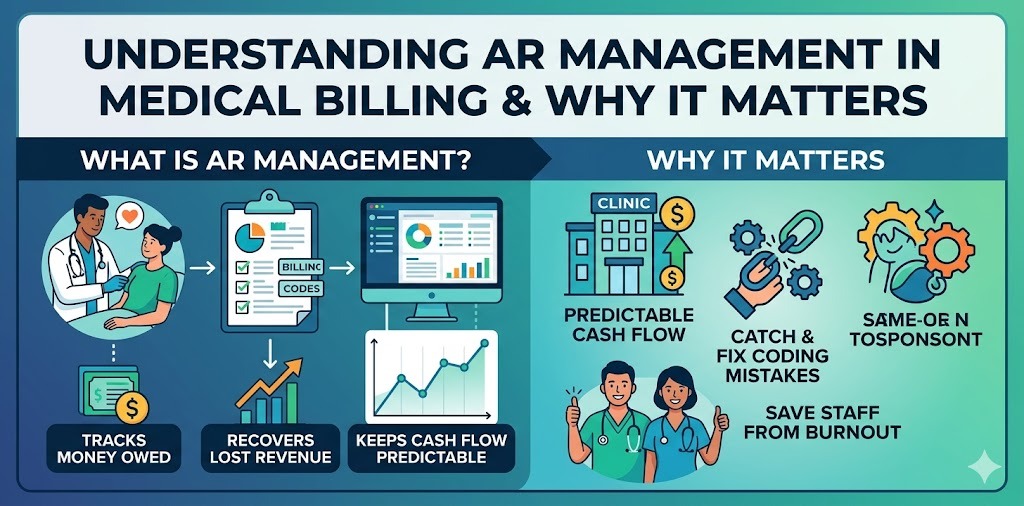
AR management is how you track the money patients and insurance companies owe you. It is a strategic way to recover lost revenue, fix denied claims, and keep your cash flow predictable. We are going to explain what AR management is, why your practice needs it, and how you can take control of your billing today.
The Basics: What Does Accounts Receivable Mean for Doctors?
In the medical billing world, accounts receivable (AR) is simply the money owed to you for services you already provided. When you treat a patient, the bill goes to the insurance company, the patient, or both. While you wait for that bill to be paid, that amount sits in your accounts receivable.
A healthy clinic usually gets paid within 30 to 45 days. But medical billing is incredibly complicated. Claims get stuck all the time. A missing modifier, a misspelled name, or a sudden insurance review can freeze your payment for months.
AR management is your system for tracking these unpaid bills. It helps you figure out why a claim is stuck and tells your team exactly what to do to get the money released.
The Real Journey of a Medical Claim
To really understand AR management, you have to look at how a claim moves through your office:
- Front Desk Registration: Your team gets the patient’s demographic and insurance details before they even see the doctor.
- Coding the Visit: A coder translates your medical notes into specific billing codes.
- Sending the Claim: Your office sends the coded claim to a clearinghouse, which then forwards it to the insurance payer.
- Posting the Payment: The insurance company sends a check or electronic transfer, and your team records it.
- The AR Follow-up: This is the cleanup phase. Your staff chases down the claims that the insurance company ignored, underpaid, or denied.
Why You Simply Cannot Ignore AR Management
You might think that insurance companies will eventually pay if you just give them enough time. That is a dangerous assumption.
Without active tracking, claims fall through the cracks. Insurance companies have strict rules and deadlines. If you miss their deadlines, they keep the money, and you have no way to fight back. Here is why a strong AR process is a requirement, not a suggestion.
Keeping the Lights On with Predictable Cash Flow
Your medical practice is a business. You need a steady cash flow to operate without stress. When your claims get older than 60 or 90 days, your cash flow takes a massive hit.
Good AR management ensures money trickles in every single week. By watching your AR aging buckets—which just means grouping your unpaid claims by how old they are—you can spot billing problems before they bankrupt your clinic.
Catching and Fixing Coding Mistakes Early
Insurance companies deny claims for the smallest reasons. A simple typo in a birth date will trigger a denial. Failing to get a prior authorization for a specific procedure will also get your claim rejected.
A smart AR management strategy does more than just chase money. It looks at the root cause of the problem. If you notice a specific insurance company keeps denying your claims for a certain blood test, your billing team can investigate. Once you fix the core error, your future claims will go through clean the first time.
Saving Your Staff from Burnout
Arguing with insurance representatives over the phone is exhausting. It drains your staff and takes their attention away from the patients in your waiting room.
A structured AR process makes this work much easier. Instead of guessing which claims to check on, your team works from a clear, organized report. They know exactly who to call and what to ask, which saves hours of wasted effort every single week.
How Unpaid Claims Secretly Hurt Your Practice
When accounts receivable pile up, the damage goes way beyond a tight budget for a few weeks.
The harsh reality of medical billing is that the older a claim gets, the less likely you are to ever see that money. The industry groups unpaid claims into four main buckets:
- 0 to 30 days: This is completely normal. The claim is processing.
- 31 to 60 days: The claim needs attention. Your staff should make a follow-up call.
- 61 to 90 days: This is the danger zone. The claim needs immediate, aggressive intervention.
- Over 90 days: This money is very hard to collect and often turns into a permanent loss.
When claims pass that 90-day mark, your chances of getting paid drop off a cliff. Government payers have very strict guidelines about timely filing. You can read the specific rules regarding claims processing and deadlines on the Centers for Medicare & Medicaid Services (CMS) website. If your practice misses a Medicare deadline because your team lost track of the claim, you forfeit that revenue completely.
Practical Steps to Fix Your AR Process
Cleaning up your accounts receivable takes consistent work. You cannot fix it in one afternoon. But if you follow these steps, you can take back control of your revenue cycle.
Start at the Front Desk
The absolute best way to handle a denied claim is to stop it from happening in the first place. Your front desk is your first line of defense.
Your front office staff needs to collect perfect demographic data. They must verify insurance active dates and benefits before the patient walks into the exam room. Even a tiny mistake, like mixing up a subscriber ID, will delay your payment for weeks. Train your front desk to double-check everything.
Send Clean Claims Fast
Do not let unbilled claims sit on a desk. Submit your charges daily. Every day a claim sits in your office is an extra day you have to wait to get paid.
You should also use a clearinghouse to scrub your claims. A clearinghouse acts like an automatic spell-checker for medical billing. It catches obvious coding errors and missing details before the claim ever reaches the insurance company.
Work the Denials Immediately
When an insurance company denies a claim, the clock starts ticking. Your team must look at the Explanation of Benefits (EOB) right away.
Find out exactly why the payer rejected the claim. Gather the missing medical records or fix the incorrect code. Then, resubmit the claim or file an appeal within the payer’s allowed time frame. Make a rule in your office that all denials must be touched and worked within 48 hours of receiving them.
Track Your Aging Reports Religiously
You need a strict routine for following up. Run an AR aging report every week.
Assign a specific person on your team to call insurance companies about claims that are hitting the 45-day mark. Ask the representative if the claim is on file and if they need more medical records. Always document the date of the call, the name of the representative, and the call reference number in your billing software.
When Should You Bring in Outside Help?
Managing accounts receivable is a full-time job. Many small and medium-sized practices just do not have enough staff to handle patient care, phone calls, and aggressive insurance follow-ups all at once.
It might be time to outsource your AR management if:
- More than 15% of your total AR is over 90 days old.
- Your staff is stressed out and falling behind on daily claim submissions.
- You are actively losing money because you missed timely filing deadlines.
- Your cash flow goes up and down unpredictably every month.
When you partner with a medical billing company, you get a team of experts whose only job is to fight for your money. This frees up your office staff to do what they do best: take care of your patients.
Secure Your Financial Health with Apex Medex
Ignoring your unpaid claims will eventually hurt your practice. Every ignored denial is money you worked hard for but will never see. By building a tough, consistent AR management system, you can get paid faster, reduce your denial rate, and keep your clinic healthy for years to come.
If your team is overwhelmed by aging claims and endless insurance phone calls, we can step in and fix it. At Apex Medex, we handle the heavy lifting of Accounts Receivable recovery. We track down your missing payments, fix the errors causing your denials, and get your cash flowing again.
Stop letting insurance companies keep your money. Contact Apex Medex today to find out how our expert AR management services can protect your practice’s bottom line.
Frequently Asked Questions (FAQs)
What is a normal number of AR days for a clinic?
A financially healthy medical practice usually keeps its average accounts receivable between 30 and 40 days. If your average creeps past 50 days, you likely have a serious bottleneck in your billing department that needs to be fixed.
How is AR management different from denial management?
AR management covers everything related to the money you are owed, from the day you send the bill to the day the check clears. Denial management is just one piece of that process. It specifically focuses on fixing and appealing the claims that the insurance company refused to pay.
How often do I need to look at my AR reports?
You should pull and review your AR aging reports once a week. Checking them weekly helps you catch stuck claims early, spot repeating coding mistakes, and appeal denials before the insurance company’s strict deadlines expire.
Recent Comments